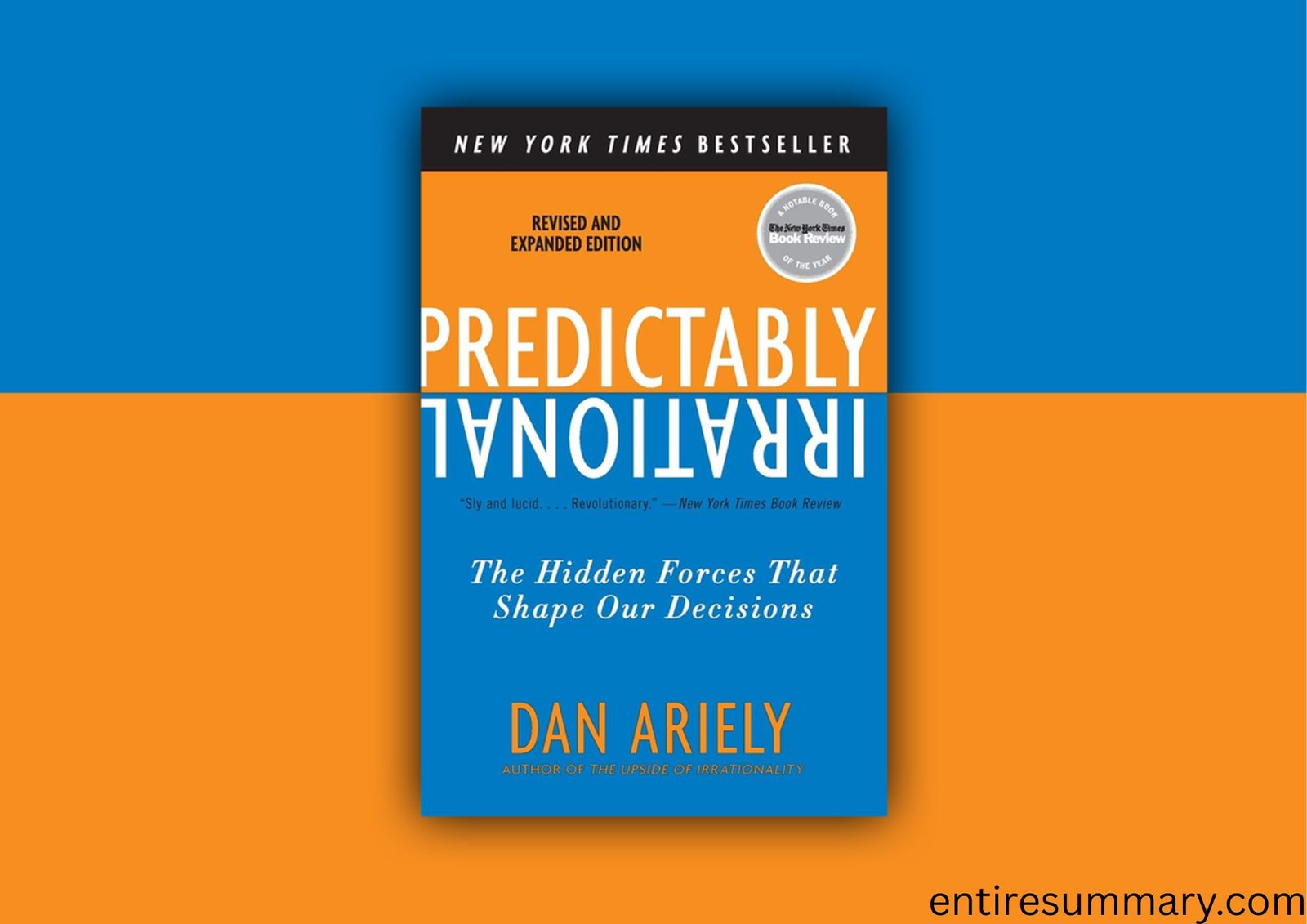
“Predictably Irrational” by Dan Ariely is a groundbreaking book that challenges the idea that we are rational decision-makers. It’s a journey into behavioral economics, a field that combines psychology and economics to explain why we make the choices we do. Ariely, a professor of psychology and behavioral economics, uses his own personal experiences, a series of clever experiments, and engaging anecdotes to show that our irrationality is not random or senseless. Instead, it is systematic and predictable. He argues that once we understand these patterns of irrationality, we can use this knowledge to our advantage and make better decisions.
The First Half: The Forces That Shape Our Choices
Ariely starts by introducing the concept of relativity, showing how we often make decisions by comparing things to each other. He uses the famous experiment involving The Economist magazine subscriptions to illustrate this. When faced with a choice between three different subscription plans—one for online access, one for a physical paper, and one for both—the majority of people picked the combined deal.
However, when the print-only option was removed, the combined option’s popularity dropped, and the web-only subscription became more popular. The presence of the “decoy” option (the print-only subscription) made the combined option seem like a much better deal, even though it wasn’t the only rational choice. This shows that our decisions aren’t based on an absolute value but on a relative comparison to other available options.
Also read: /the-interpretation-of-dreams/
Dan Ariely makes the point that we live in two separate worlds at once: the one ruled by social norms and the one ruled by market norms. In the world of market norms, we expect payment for our work and we are driven by self-interest. In the world of social norms, we do things out of kindness, friendship, or a sense of community, with no expectation of financial reward. The two norms don’t mix well.
For example, if you offer to pay a friend for helping you move, you might insult them. That’s because you’ve shifted the interaction from the world of social norms to the world of market norms, changing the entire dynamic. This insight helps explain why some companies fail when they try to use financial incentives to encourage behavior that should be governed by social norms, like volunteering.
Ariely also delves into the concept of “The Cost of Zero.” We often think of free things as being a great deal, but he argues that “free” is a powerful motivator that can lead us to make irrational decisions. He shows how we will go to great lengths to get something for free, even if a slightly more expensive but better-quality alternative is available. The word “free” has an emotional pull that is hard to resist, causing us to overvalue things that cost nothing.
Predictably Irrational continues with a discussion of the influence of emotions. Ariely argues that when we are in a heightened emotional state—whether it’s anger, excitement, or sexual arousal—we make decisions that we wouldn’t otherwise. He calls this the “hot state,” and he suggests that it is a powerful force that can override our rational thinking. This is why people might overeat when they are sad or make impulsive purchases when they are excited. The first half of Predictably Irrational lays a powerful foundation, showing us that our brains are wired with these systematic errors that lead to predictable and often irrational behavior.
The Second Half: Why We Make Bad Decisions and How to Fix Them
In the second half of Predictably Irrational, Ariely takes the concepts from the first half and applies them to more complex human behaviors. He explores the idea of “procrastination and self-control.” He explains that we often have good intentions, but our immediate impulses get the better of us. We know we should save for retirement or go to the gym, but we’re tempted by instant gratification. Ariely suggests that one way to combat this is by “pre-commitment,” which involves making a decision in advance that limits our future choices. For example, by setting up an automatic transfer to a savings account, you can’t spend that money, effectively pre-committing yourself to saving.
Predictably Irrational also addresses the surprisingly irrational power of ownership, a concept known as the “endowment effect.” We tend to overvalue things we own simply because we own them. Ariely demonstrates this with an experiment involving a basketball game ticket. Students who owned the ticket valued it much more than those who didn’t, even though the market value was the same. This irrational attachment to our possessions explains why it’s so difficult to sell things we’ve had for a long time or why we might not trade a car we own for a better one.
Ariely also looks at how a person’s expectations can lead them to act in ways that don’t make sense. He shows how our preconceived notions and beliefs can influence our perception of an experience. He did an experiment, for example, where he gave people a cup of coffee. When he told people the coffee had a special, secret ingredient, they rated it as tasting better than when he didn’t. This demonstrates that our expectations can create a self-fulfilling prophecy, shaping how we perceive things from the quality of a product to the effectiveness of a painkiller.
He also explains how the presence of a moral dilemma can lead people to cheat in small ways. He found that if you remove the link to money—for example, by having people be paid in tokens instead of cash—they are more likely to cheat. This suggests that there is a mental distance from the act of cheating that makes it easier to justify.
The book builds to the powerful conclusion that we aren’t as logical and self-serving as we believe ourselves to be. We are predictable in our irrationality, which is a hopeful idea because it means we can learn to recognize our systematic errors and design our lives and systems to account for them. The resolution is Ariely’s call to action: to understand our irrationality, accept it, and then work to overcome it in order to make better decisions for ourselves and for society.
Key Takeaways
- Our decisions are often relative. We judge things by stacking them up against other choices, not by looking at them on their own.
- Social and market norms operate on different principles. Mixing them can lead to unexpected and often negative outcomes.
- “Free” is a powerful motivator. We are irrationally drawn to things that are free, even if a better but slightly more expensive option is available.
- We are creatures of habit and emotion. Our impulses and our ownership of things can lead us to make choices we later regret.
- Our irrationality is predictable. By understanding the systematic errors we make, we can design better systems and make better decisions.
FAQs
What is the biggest takeaway from “Predictably Irrational”?
The biggest takeaway is that we are not rational decision-makers. Our behavior is influenced by powerful, predictable forces that we are often unaware of, but we can learn to recognize and manage them.
How is this book different from “Nudge”?
While both books are in the field of behavioral economics, “Predictably Irrational” focuses more on explaining the “why”—the psychological forces behind our irrationality. “Nudge,” on the other hand, focuses more on the “how”—the practical application of these insights to design systems that help people make better choices.
What is the “endowment effect”?
We have a habit of overvaluing things just because we own them. Once we possess something, we feel a sense of attachment that makes it difficult to give it up, even for a reasonable price.
How can I use these ideas to make better financial decisions?
Recognize your own biases. To avoid overspending, you can set a budget and use cash instead of a credit card to make the cost feel more real. To save money, set up an automatic transfer to a savings account to remove the need for self-control.
Does Ariely suggest we are completely helpless against our irrationality?
No, on the contrary. The book is an optimistic one. By making us aware of our predictable irrationality, Ariely gives us the tools to recognize when we are about to make a poor decision and to set up systems that help us to make better ones.
What is “the decoy effect”?
The decoy effect, as shown in the Economist subscription example, is when adding a third, less appealing option makes a second, more appealing option seem like a better choice. That is a great observation. The way a decoy works is by making one of the other options seem much better in comparison, which guides us toward a specific choice.
Is this book a criticism of human nature?
Not at all. The book is a compassionate look at why we make the choices we do. It is not about judging us for our flaws but about understanding them so we can live more effective and productive lives.
Final Thoughts
“Predictably Irrational” is a must-read for anyone who wants to understand why we do the things we do. It is filled with fascinating stories and experiments that are both entertaining and deeply insightful. It’s a book that will make you look at your own decisions—and the world around you—in a whole new light. If you enjoyed this book, you might also like “Thinking, Fast and Slow” by Daniel Kahneman and “The Power of Habit” by Charles Duhigg.