
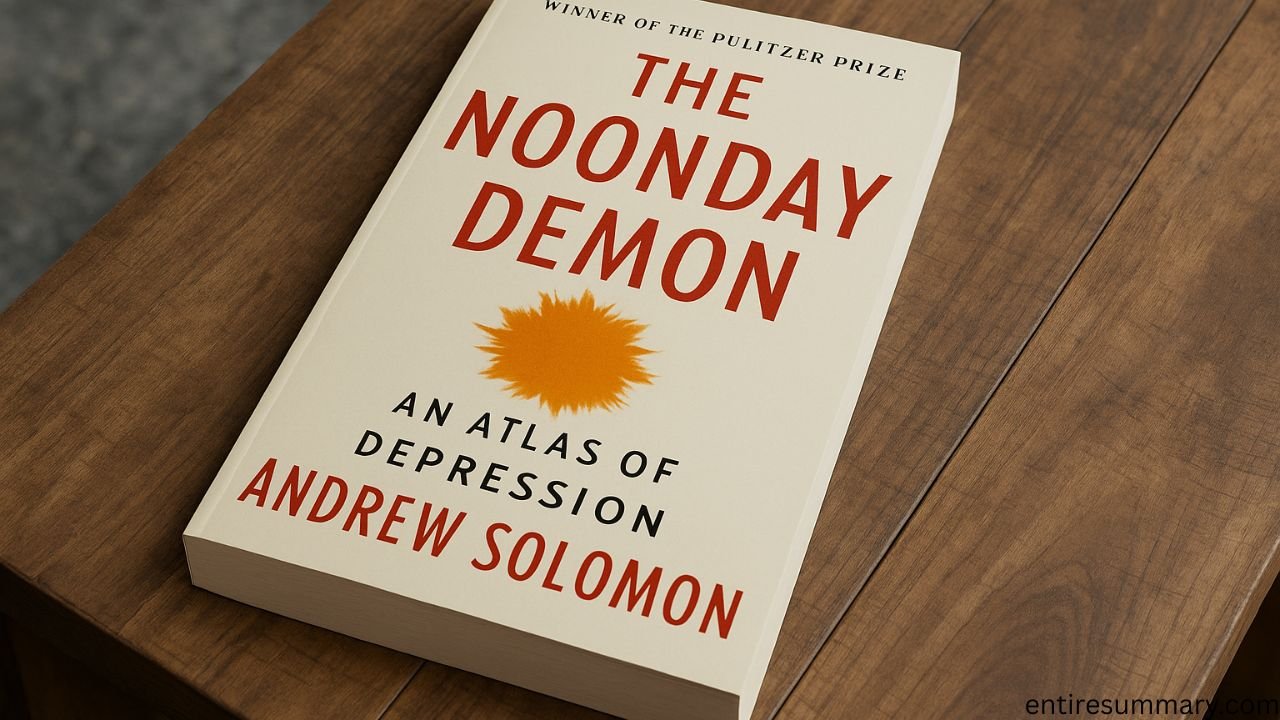
The Noonday Demon: An Atlas of Depression by Andrew Solomon is an award-winning blend of memoir, journalism, and scientific exploration. Part personal account and part cultural study, the book examines depression in all its dimensions — medical, social, political, and deeply personal. It’s widely regarded as one of the most thorough and compassionate works on mental health, offering insight into both the suffering depression causes and the hope for recovery.
First Half Summary: Key Events and Themes
The start of The Noonday Demon is very personal to the author. Solomon recounts his own battle with severe depression in his 30s. He describes waking up with unbearable weight in his chest, unable to function, think clearly, or find meaning in anything. His descriptions are raw and unflinching, making it clear that depression is not just sadness but a debilitating illness that hijacks the mind and body.
From there, Solomon begins to explore depression from multiple angles:
- Personal Experience: His journey with antidepressants, therapy, and hospitalizations.
- He provides a scientific perspective by exploring the biological aspects of depression, such as brain chemistry, genetics, and the effectiveness of different treatments.
- Cultural Views: Solomon looks at how different societies perceive and treat depression, showing how stigma and silence often worsen suffering.
- Historical Context: He traces the history of how depression has been understood over time, from “melancholia” in ancient writings to modern psychiatric definitions.
He also weaves in stories of people he interviewed across the world — individuals who faced depression in different contexts, from poverty to political oppression. These accounts highlight that while depression is universal, how it is treated (or ignored) depends heavily on cultural and social factors.
Also read: /lost-connections/
By the midpoint of the book, readers see depression not only as a personal struggle but also as a public health crisis that demands broader understanding and compassion.

Second Half Summary: From Climax to Ending
In the second half, Solomon moves beyond his own struggles to focus on the broader implications of depression.
- Treatment Approaches: He discusses medication, psychotherapy, electroconvulsive therapy (ECT), and alternative practices. He is candid about the trial-and-error nature of treatment, noting that what works for one person may fail for another.
- Politics of Mental Health: Solomon critiques the lack of government funding for mental health care and the inequality in access to treatment. He argues that mental illness is as serious as physical illness and deserves the same urgency in policy.
- Family and Relationships: He explores how depression affects families, often straining bonds but also, at times, creating deeper empathy and understanding.
- Depression and Society: Solomon shows how poverty, war, and trauma intensify the risk and severity of depression, making it not only a medical issue but also a social one.
- Although the book explores dark themes, it concludes with a message of hope and recovery. Solomon stresses that depression is treatable, even if not always curable. His personal story — moving from despair to functionality — stands as proof that recovery is possible.
The climax of the book lies not in a single dramatic event but in Solomon’s gradual acceptance: depression may always be a part of his life, but it doesn’t have to define it. He learns to live with vulnerability while still seeking joy and purpose.
Key Takeaways
- Depression is far more complex than simple sadness — it is a serious medical and social illness.
- Treatment often involves trial and error, combining therapy, medication, and lifestyle changes.
- Stigma and silence worsen suffering; open conversations save lives.
- Depression is shaped by culture, economics, and politics, not just biology.
- Recovery doesn’t mean the complete absence of depression but finding ways to live meaningfully alongside it.

FAQs
1. Who is the author of The Noonday Demon?
Andrew Solomon, a writer and lecturer on psychology, politics, and culture.
2. What genre is the book?
The book combines personal stories, in-depth research, psychological insights, and observations on society.
3. What does the title mean?
“The Noonday Demon” is a metaphor for depression, taken from medieval writings describing despair as a demon that attacks at midday.
4. Is the book only about the author’s depression?
No, it combines Solomon’s personal story with scientific research and interviews with people around the world.
5. Does the book discuss treatments?
Yes, it covers antidepressants, therapy, ECT, and other medical and alternative treatments.
6. Is the book hopeful or depressing?
While it describes the pain of depression in detail, it ultimately offers hope through stories of recovery and resilience.
7. Who should read this book?
Anyone interested in understanding depression — whether personally, academically, or professionally.
8. How long is the book?
It’s about 500 pages, offering both detailed research and personal narrative.
9. Did the book win awards?
Yes, it won the National Book Award for Nonfiction in 2001 and was a finalist for the Pulitzer Prize.
10. What is the central theme of the book?
That depression is not a weakness but a serious illness, and with treatment and support, people can recover and live meaningful lives.
